Passive Voice

Passive Voice

Готовы немного пострадать над английским? Тогда начнем. Глаголы в английском языке употребляются в активной форме залога — «the Active Voice» и в пассивной (страдательной) — «the Passive Voice». В активном залоге субъект выполняет действие, указанное глаголом, а в пассивном — на субъект действует сам глагол. She wrote a book (Active) – A book was written by her (Passive). So easy! Но давайте на всякий случай уточним некоторые детали. C'mon.

Что такое пассивный залог?
Пассивный залог широко употребляется как в устном так и в письменном современном английском. Зачастую пассивные конструкции используются, когда нет необходимости называть исполнителя какого-либо действия, а также, если нет разницы в том, кто именно это действие выполняет — важен лишь результат.
Страдательный залог используется, чтобы показать интерес к объекту, который испытывает действие, а не к объекту, который его выполняет.

В этом предложении подлежащее «the book» испытывает на себе действие субьекта, то есть не сама книга себя написала, а была кем-то написана. При этом, скорее всего, известно, кто ее написал, но здесь важен сам факт совершения действия (книгу написали, и она готова), а не исполнитель. Поэтому предложение и употреблено в пассивном залоге.

Когда необходимо указать исполнителя действия в пассивном залоге, то добавляем предлог «by»: The book was written by me. – Эта книга была написана мной.

Образование пассивного залога в разных временах
Пассивный залог образуется с помощью вспомогательного глагола «be» и формы Past Participle (смыслового глагола в 3 форме) и только переходные глаголы (обозначают действие, которое по своему смыслу переходит на некий предмет) могут образовывать формы пассивного залога.

Образование пассивного залога

Present Simple
is/am/are + Ved (V3)
Mails are sent every day. – Посылки отправляют каждый день.
Past Simple
was/were + Ved (V3)
Mails were sent yesterday. – Посылки отправили вчера.
Future Simple
will/shall + be + Ved(V3)
Mails will be sent tomorrow. – Посылки отправят завтра.
Present Continuous
is/am/are + being + Ved (V3)
Mails are being sent now. – Посылки отправляют сейчас.
Past Continuous
was/were + being + Ved (V3)
Mails were being sent at 5 yesterday. – Посылки вчера отправляли в 5 часов.
Future Continuous -----

Present Perfect
has/have + been + Ved (V3)
Letters have been already sent. – Письма уже отправили.
Past Perfect
had + been + Ved (V3)
Letters had been sent before he phoned. – Письма отправили до того, как он позвонил.
Future Perfect
will/shall + have/has+ been +Ved (V3)
Letters will have been sent by 5 tomorrow. – Письма отправят завтра до 5 часов.
Perfect Continuous-----

Attention: Perfect Continuous вообще не используется в страдательном залоге. А время Continuous не имеет будущего отрезка.

Інші блоги вчителя

Geography

The United Kingdom of Great Britain and Northern Ireland

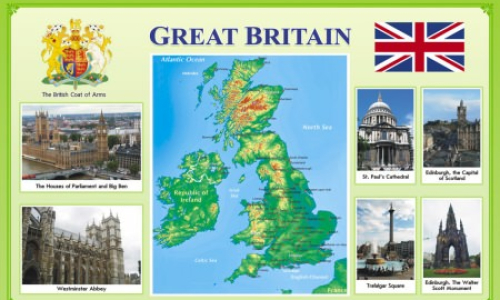
The United Kingdom of Great Britain and Northern IrelandThe United Kingdom of Great Britain and Northern Ireland is situated on two large islands called the British Isles. The larger island is Great Britain, which consists of three parts: England, Scotland and Wales. The smaller island is Ireland and there are about five thousand small islands.The country’s shores are washed by the Atlantic Ocean, the North Sea and the Irish Sea. The English channel separate Great Britain from the continent.The total area of the U.K. is 244.00 square kilometers with a population of 56 million. It is one of the most populated countries in the world. The average density of population is very high: about 220 people per square kilometer. The greater part of the population is urban. About 80 percent of people live in numerous towns and cities. More then seven million people live in London area. Very often the inhabitants of The United Kingdom and Northern Ireland are called English.The surface of the British Isles varies very mach. There are many mountains in Scotland, Wales and northwest of England but they are not very high. Ben Nevis in Scotland is the highest mountain. The northern part of Scotland is mountainous and is called the Highlands. Scotland is also famous for its beautiful lakes, which are called Lochs.The mountains in G.B. are not very high. There are many rivers in G.B., but they are not very long. The Themes is the deepest, the longest and the most important river in England.The climate of G.B. is mild. It is not very cold in winter and hot in summer. The average temperature in January is about 5C above zero. February is the coldest month in the year. The summers are cool and rainy. July is the warmest month. There is much rain and flog in autumn and winter. October is the rainiest month in the year.
Geography

Big cities of the United Kingdom

Big cities of the United Kingdom / Большие города ВеликобританииThe biggest cities of the United Kingdom are also great industrial and cultural centres. The biggest city of the country is London. The population of Greater London is now over 8 million people. Lots of men and women crowd the city at day-time. They are engaged in the vast international business of London which has made it like no other place in the world. Many of the present-day commercial, financial, and civic institutions of the city have their roots in the 16th century, and some go even deeper. London is also a cultural centre of the England. The British Museum, located here is the largest in the world. In the evening you may choose between more than 50 theatres of the city. Among most famous city attractions are also Buckingham Palace, the Houses of Parliament, St. Paul’s Cathedral, Westminster Abbey, the Tower of London and many others.Other big and famous cities of the United Kingdom are Birmingham, Glasgow, Liverpool, Manchester, Edinburgh, Belfast and others. They are famous for its companies, unique character and history. Birmingham is long famous as an international business centre. It has developed into a modern and exciting city, which buildings and shops are second to none. Birmingham is at heart of Britain’s motorway system. Massive post-war development brought exciting new buildings, but the best of the old ones have been preserved. The city’s museum and art gallery has some of the finest examples of European painting. Birmingnam’s ultra-modern library is one of the largest and best stocked in Europe and includes the Shakespeare Memorial Library with 40,000 books in 90 languages. The city possesses several interesting churches and two cathedrals.Edinburgh, the capital of Scotland, is also a great city of more than half a million inhabitants. The city is built of stone, not brick. The houses look hard and solid. Some people would call them grim, especially on a wet day, but when the sun shines beautifully in the city the city looks fine. Its many bookshops, taverns, and clubs some of world-famous people visited at different times. Among them were Dr. Johnson and Robert Burns. One of the famous avenues in the world is the Prince’s Street in Edinburgh. It is the finest street and a shopping area of the city.Glasgow is the third largest city of Great Britain. You may feel its industrial energy everywhere in the city. The city extends along both banks of the river Clyde. With each phase of its development it has stretched, until its outskirts now lie several miles from the city centre. It is, by far, the largest and most populous city in the whole of Scotland. Glasgow is known the world over for its ship-building. Glasgow-built locomotives run in every part of the world. Today Glasgow is of such a size that it extends far over both banks of the river Clyde and bridges are as essential for the conduct of activities as are the people themselves. Within a distance of a mile there are 7 bridges. They carry road and rail traffic in and out of the city. No other city of Scotland has or needs as many river crossings as Glasgow.Cardiff, the capital of Wales, lies near the mouth of the river Taff. In the days of our great-grandparents Cardiff was a tiny village. Today there are about a quarter of a million people living there. Cardiff is now the largest town in Wales and is noted for its coal. There is also a delightful park in the city which everyone tries to see. This is Cathay’s Park. Few towns in the world have such fine public buildings as Cardiff. The Law Courts, City Hall and University buildings in Cathay’s Park are worthy of any city in the world. The United Kingdom of Great Britain and Northern Ireland have many other cities and towns, that attract thousands of people from all over the world either on business or private visit.Словарьsecond to none — непревзойденный best stocked — хорошо укомплектованный (книгами)Dr. Johnson — известный английский лексикографto stretch — протягиватьсяpopulous — населенныйessential — необходимый
Talking Flashcards (Youtube Channel)
В эту группу входят существительные, которые используются с артиклем the. В картах названия принято давать без артиклей, чтобы они занимали меньше места.

Артикль the с географическими названиями

Определенный артикль употребляется с географическими названиями, которые обозначают:Стороны света (cardinal points):the North / the north – Север (как территориальное обозначение) / север (как направление);the South / the south – Юг (как территориальное обозначение) / юг (как направление);the East / the east – Восток (как территориальное обозначение) / восток (как направление);the West / the west – Запад (как территориальное обозначение) / запад (как направление).Обратите внимание, когда мы обозначаем направление, то можем использовать и определенный артикль, и нулевой.The downtown is to the north of the city. – Центр города находится севернее.They were going from east to west. – Они шли с востока на запад.Полюса, полушария (poles, hemispheres):the North Pole – Северный полюс;the South Pole – Южный полюс;the Western Hemisphere / the western hemisphere – Западное полушарие (как территориальное обозначение) / западное полушарие (как направление);the Eastern Hemisphere / the eastern hemisphere – Восточное полушарие (как территориальное обозначение) / восточное полушарие (как направление);the Northern Hemisphere / the northern hemisphere – Северное полушарие (как территориальное обозначение) / северное полушарие (как направление);the Southern Hemisphere / the southern hemisphere – Южное полушарие (как территориальное обозначение) / южное полушарие (как направление).Регионы (regions):the Far East – Дальний Восток;the north of Canada – север Канады;the Middle East – Ближний Восток;the Highlands – Северо-Шотландское нагорье;the south of England – юг Англии;the Caucasus – Кавказ.Страны (countries), названия которых представляют собой существительные во множественном числе:the Philippines – Филиппины;the Netherlands – Нидерланды;the United States of America – США;the United Arab Emirates – Объединенные Арабские Эмираты;the Baltic States – Прибалтика.Страны, в названии которых есть слова kingdom (королевство), republic (республика), federation (федерация):the United Kingdom of Great Britain and Northern Ireland – Объединенное Королевство Великобритании и Северной Ирландии;the Kingdom of Denmark – Королевство Дании;the Republic of Cuba – Республика Куба;the German Federal Republic – Федеративная Республика Германии;the Russian Federation – Российская Федерация;the Czech Republic – Чешская Республика;the People’s Republic of China – Китайская Народная Республика.Если же называть страну без слов «республика», «королевство», «федерация», то артикль не нужен:Germany – Германия;Denmark – Дания;Russia – Россия.Океаны (oceans), проливы (straits), моря (seas), реки (rivers), каналы (canals/channels), течения (currents):the Atlantic Ocean – Атлантический океан;the Pacific Ocean – Тихий океан;the Indian Ocean – Индийский океан;the Black Sea – Черное море;the Dead Sea – Мертвое море;the Red Sea – Красное море;the Thames – Темза;the Volga – Волга;the Don – Дон;the Suez Canal – Суэцкий канал;the Strait of Magellan – Магелланов пролив;the Bosporus – пролив Босфор;the Bering Strait – Берингов пролив;the English Channel – Ла-Манш;the Panama Canal – Панамский канал;the Strait of Dover – Дуврский пролив / Па-де-Кале;the Strait of Gibraltar – Гибралтарский пролив;the Amazon – Амазонка;the Nile – Нил;the Gulf Stream – течение Гольфстрим;the Sea of Japan – Японское море.Полуострова (peninsulas), мысы (capes):the Indochinese Peninsula – полуостров Индокитай;the Balkan Peninsula – Балканский полуостров;the Iberian Peninsula – Пиренейский полуостров;the Cape of Good Hope – мыс Доброй Надежды.Здесь есть несколько исключений:Cape Horn – мыс Горн;Cape Chelyuskin – мыс Челюскин.Группы озер (groups of lakes):the Great Lakes – Великие озера;the Seliger – Селигер.Обратите внимание: если рядом с названием озера используется слово lake, то определенный артикль не нужен:Lake Baikal – озеро Байкал;Lake Ontario – озеро Онтарио;Lake Geneva – Женевское озеро.Группы островов (groups of islands):the Virgin Islands – Виргинские острова;the Canary Islands (the Canaries) – Канарские острова (Канары);the British Isles – Британские острова;the Bahamas – Багамы;the Azores – Азорские острова;the Falkland Islands – Фолклендские острова.Горные массивы (chains of mountains), холмы (hills):the Black Hills – Черные холмы;the Apennines – Апеннины;the Rocky Mountains – Скалистые горы;the Andes – Анды;the Urals – Уральские горы;the Alps – Альпы;the Margalla Hills – холмы Маргалла;the Seven Hills of Rome – семь холмов Рима;the Chocolate Hills – Шоколадные холмы;the Himalayas – Гималаи.Равнины (plains), долины (valleys), пустыни (deserts):the Great Plains – плато Великие равнины;the Willamette Valley – долина Уилламетт;the Jezreel Valley – Изреельская долина;the Mississippi Valley – долина Миссисипи;the Sahara Desert – пустыня Сахара;the Karakum Desert (the Kara Kum, the Kara-Kum) – Каракумы, пустыня Каракумы;the Kalahari Desert – Калахари;the Arabian Desert – пустыни Аравийского полуострова.Обратите внимание: с названиями многих долин артикль не используется. Мы рекомендуем всегда проверять такие имена собственные в словаре, чтобы не ошибиться, например:Death Valley – Долина Смерти;Yosemite Valley – долина Йосемити;Monument Valley – Долина монументов.Заливы (gulfs/bays). Если в названии залива есть предлог of, то мы ставим артикль the, если предлога нет, артикль не нужен:the Gulf of Mexico – Мексиканский залив;the Gulf of Finland – Финский залив;the Gulf of Aden – Аденский залив;the Bay of Bengal – Бенгальский залив.Hudson Bay – Гудзонский залив;San Francisco Bay – залив Сан-Франциско.Мы узнали, какие существительные используются с определенным артиклем. Теперь настал черед географических названий, которые в английском языке принято использовать без артикля.Нулевой артикль с географическими названиямиНулевой артикль используется со следующими названиями:Названия континентов (continents):Europe – Европа;Africa – Африка;South America – Южная Америка;North America – Северная Америка;Australia – Австралия;Asia – Азия.Страны, названия которых представляют собой существительные в единственном числе, города (cities), села (villages), штаты (states), провинции (provinces):France – Франция;Spain – Испания;California – Калифорния;Kiev – Киев;London – Лондон;Beijing – Пекин;Florida – Флорида;Quebec – Квебек.Здесь есть несколько исключений, к ним относятся:the Hague – Гаага;the Vatican – Ватикан;the Congo – Конго.Если в названии города появляется слово city, то тут же появляется определенный артикль и предлог of:the city of Moscow – город Москва;the city of Rome – город Рим.Названия отдельных островов (islands), гор (mountains), вулканов (volcanoes):Greenland – Гренландия;Java – Ява;Cyprus – Кипр;Madagascar – Мадагаскар;Jamaica – Ямайка;Vesuvius – Везувий;Mount Goverla – Говерла;Elbrus – Эльбрус;Kilimanjaro – Килиманджаро;Mount Etna – вулкан Этна;Mount Fuji – Фудзи, Фудзияма.Теперь вы знаете, какой артикль должен употребляться с тем или иным географическим названием. Чтобы закрепить полученные знания, рекомендуем скачать документ, в котором собраны слова по теме, и пройти тест.
тест

Артикль the с географическими названиями

https://engblog.ru/goto/https://engblog.ru/app/upl...
Таблица
ВчителіФотоВідеоПошукГостьова